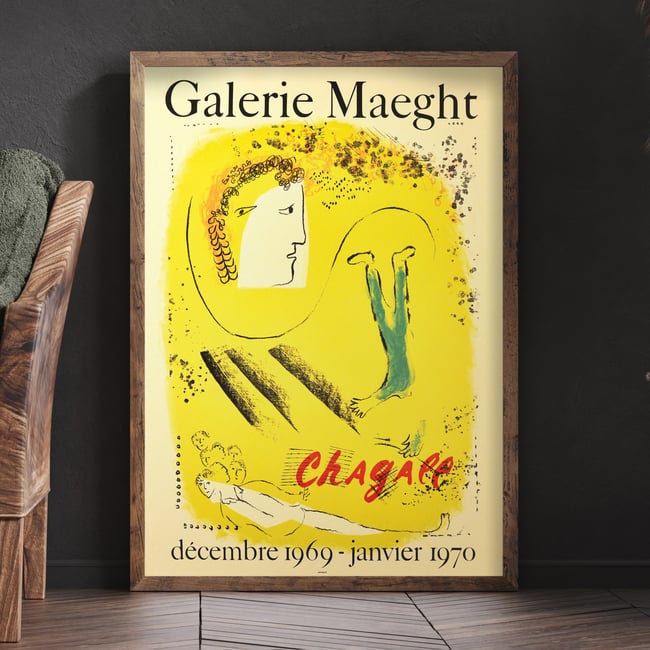
Why did Chagall use so much yellow in his art?
Chagall used yellow not just for brightness but for symbolism.
For him, yellow represented:
-
Light
-
Joy and celebration
-
Spiritual radiance
-
Warmth and inner happiness
It often acts like a halo that floods the scene with emotional light. In many works, the yellow background feels as if the sun is shining from within the painting itself.
Why are the yellow backgrounds in the Le Cirque series so popular?
Because the circus theme is so full of movement and magic, the glowing yellow helps to:
-
create festive energy,
-
highlight the acrobats and performers,
-
and give the scene a dreamlike, suspended moment.
The yellow background feels like a spotlight, turning every performer into the star of their own dream. These pieces are often the most visually striking in the series.
Does yellow have a symbolic meaning in Chagall’s personal story?
Yes. Chagall associated yellow with his memories of childhood in Vitebsk, the warm glow of village life, and his lifelong interest in spirituality. Yellow appears in:
-
his depictions of lovers,
-
his circus performers,
-
and religious themes.
It is the color he used to express inner light, nostalgia, and a sense of the miraculous.
Why do yellow-background Chagalls attract collectors?
Several reasons:
-
Strong visual identity — They are instantly recognizable.
-
High contrast — Figures in blue, red, or black “pop” dramatically against yellow.
-
Emotional warmth — They feel cheerful and uplifting.
-
Rarity — Not all Chagall prints use bold yellow, so the ones that do stand out.
This makes yellow-background lithographs especially desirable in the art market.
How does yellow change the atmosphere of a Chagall artwork?
Yellow acts like a theatrical backdrop:
-
It removes depth, so figures float weightlessly.
-
It bathes the entire scene in a glowing aura.
-
It creates a feeling of timelessness and magic.
Chagall often said he wanted to paint “not the world as it is, but the world as it should be.” Yellow was his way of painting the world lit from within.
Are certain Chagall yellow works considered more iconic?
Yes—especially the circus and acrobat lithographs from the 1960s. These include pieces featuring:
-
trapeze artists,
-
violinists,
-
clowns and riders,
-
floating animals,
-
lovers.
They are frequently reproduced in books and museum exhibitions because they embody Chagall’s dreamlike universe so perfectly.